

Welcome to Australia, the nation Labor rigged. Not just Labor but the progressive left establishment across society has established a state ideology, a system of orthodox beliefs (more unrelenting than medieval Christianity), which is increasingly imposed across all walks of life. The tendency is towards a one-party state, even if different party labels are preserved. The Albanese/Chalmers budget is a giant step towards creating a southern hemisphere European welfare state. This relies on ultimately ruinous levels and types of welfare. It greatly exaggerates the power of the state in all spheres of life and tends to crony capitalism and corporate state structures. It brings a vast machinery of political orthodoxy ∼ progressive ideology ∼ which it's increasingly difficult to be free of. In a democracy the state is meant to be, as far as possible, politically neutral. In Australia, institutions that should be neutral have been politicised, while fresh institutions have been created for political purposes. Governments spend billions of dollars to coerce Australians into seeing reality through a leftist, progressivist lens, then enforcing them to live their lives accordingly. — Greg Sheridan in the Oz today
.A Swans/Storm Saturday and Popovic's soccer present
The Storm exercised its supremacy beating the Roosters 18-4 while the West Tigers kept the Bulldogs at bay 22-16 while the Knights contained the Eels 28-22. However, the real excitement was in the AFL with the Swans climbing all over Richmond 170-56 and Fremantle curbing Brisbane 103-78. The Bulldogs only just managed to keep Collingwood in hand 97-93. [click to read more]
Robbie Slater muses in the Oz what a coup for Tony Popovic — the fight to get exciting attacker Cristian Volpato in a Socceroos jersey has been going on for years.
We have to give Popovic a lot of credit for the role he played in this.
Volpato adds firepower, which is crucial after the loss of Riley McGree to a hamstring injury.
I've seen a lot of criticism online about the decision but, regardless, we need him.
Volpato has made his choice, it doesn't matter why it has taken so long — everyone needs to support him now because he is a Socceroo.
It will be interesting to see how Popovic plans to use Volpato — will he form part of the starting side or come off the bench?
Everyone wants to be part of that starting XI for the opening match of the FIFA World Cup and this clash with Mexico is their last chance to fight for it.
I think we can safely say that Popovic has locked in seven of his 11 players for the starting side.
That means there are four spots up for grabs, on top of that three other players are fighting to keep their name on that 26-man squad list submitted to FIFA on Monday.
In-form goalkeeper Mat Ryan, who played a big role in saving his Spanish club Levante from relegation, has proven he deserves to keep that No. 1 jersey. He will be coming in on a big high.
Alessandro Circati and Cameron Burgess will take up two of the three centre-back spots with Harry Souttar the most likely third.
Jordy Bos, our best player on the team, will take the left-back role.
The right-back position though will be one of the big areas Popovic uses this hit out against host nation Mexico to test. [click the intro to return other stories]
Euphoric sentiment in the market
Wall Street’s main indexes hit record closing highs on Friday and posted weekly and monthly gains as Dell results drove tech shares higher, while investors awaited details on a potential U.S.-Iran deal, Reuters reports on today's website. [click to continue reading]
President Donald Trump said in a social media post that he would make a final decision on the Iran deal on Friday. Tehran earlier said it was looking for action, not words, when it came to an agreement.
Dell surged 32.8% after raising its full-year profit and revenue forecasts on Thursday. The tech sector climbed 1.87%, fueled by gains in chip stocks.
Peers Hewlett Packard Enterprise and Super Micro Computer gained 12.6% and 11.6% respectively. Microsoft climbed 5.4%.
The software services index also advanced by over 6%, erasing all losses since January-end, when concerns over AI disruption had weighed on the sector.
Earlier in the session, all three indexes hit intraday record highs, cruising on renewed optimism around AI and strong earnings growth, despite concerns about the Iran war’s impact on inflation and the global economy.
The Dow Jones Industrial Average rose 363.37 points, or 0.72%, to 51,032.34, the S&P 500 gained 16.44 points, or 0.22%, to 7,580.07 and the Nasdaq Composite 55.15 points, or 0.21%, to 26,972.62.
The small-cap Russell 2000 index was down 0.6%.
For the week, the S&P 500 gained 1.43%, the Nasdaq rose 2.39%, and the Dow climbed 0.9%. The Russell 2000 index rose 1.72%.
For the month, since April 30, the S&P 500 gained 5.15%, the Nasdaq rose 8.36%, and the Dow climbed 2.78%. The Russell 2000 index rose 4.24%.
The S&P 500 registered its ninth consecutive weekly gain, its longest winning streak since December 2023.
There’s definitely euphoric sentiment in the market around AI. The rally has really been driven by earnings,
said Ohsung Kwon, chief equity strategist at Wells Fargo.
He suggested investors buy and hold AI stocks, then earn extra income by selling call options at prices much higher than the current stock price.
Melissa Brown, head of investment decision research at SimCorp, said over the past few weeks volume has gone up, which suggests more people are coming into the market.
The S&P 500 communications services sector dropped, as Alphabet declined by 2.5%.
Consumer staples shares were weak, with heavyweights Costco and Walmart down 3.9% and 2.6% respectively.
The S&P automaker index dropped after reports the Trump administration wants North American-built vehicles to have 82% regional content to qualify for preferential treatment under the U.S.-Mexico-Canada Agreement.
Shares of General Motors fell 1.3% and U.S.-listed shares of Stellantis dropped 2.7%.
U.S. economic data on Thursday showed inflation increased at its fastest pace in three years in April, while GDP for the first quarter was revised lower to a 1.6% annual rise.
The Fed’s Kansas City president Jeffrey Schmid warned the energy shock may not be temporary. Vice chair for Supervision Michelle Bowman said a persistent rise in inflation might require tighter monetary policy.
Money markets expect the Federal Reserve to keep interest rates steady for the rest of the year, with expectations of a 25-basis-point hike in December.
Among other movers, Gap shares tumbled 15.4% after the apparel retailer cut its annual sales forecast, while American Eagle Outfitters dropped 11.8% after keeping its annual comparable sales forecast unchanged.
Declining issues outnumbered advancers by a 1.04-to-1 ratio on the NYSE. There were 491 new highs and 102 new lows on the NYSE.
On the Nasdaq, 2,378 stocks rose and 2,486 fell as declining issues outnumbered advancers by a 1.05-to-1 ratio.
The S&P 500 posted 27 new 52-week highs and 12 new lows while the Nasdaq Composite recorded 125 new highs and 54 new lows.
Volume on U.S. exchanges was 23.9 billion shares, compared with the 19.36 billion average for the full session over the last 20 trading days.
NEWS:
🌿
Killing a
few more
than weeds
Paraquat was hailed as a wonder poison for Australian farmers but 60 years since its introduction, those stricken with parkinson’s disease are counting the cost, reports The Australian today's website.
[click to read more]
Kevin Treeby is a man of soil and sweat and simplicity. A lifetime’s farming has left his face leathered, his palms calloused. His body has grown used to the repeated frictions and irritations of working his land, encouraging crops to grow. Spring after spring in WA’s remote Gairdner River region, six hours' drive southeast of Perth, Treeby planted 1400ha of wheat and barley while raising his three children with his wife of 52 years, Jenny.
Never did he imagine that a toxic herbicide, paraquat ∼ the weedkiller of choice for grain farmers across the country ∼ may have sown the seeds of his own destruction.
Kevin Treeby has been diagnosed with parkinson’s disease. He is far from alone in Western Australia’s fertile wheatbelt and Great Southern regions, where parkinson’s is ravaging farmers in numbers that suggest a previously unidentified cluster of the disease. While there is a scarcity of hard data on cases in Australia, statistics published by Parkinson’s Australia estimate the wheatbelt has as many parkinson’s sufferers as inner Perth, where there is three times the population. Epidemiologists have studied similar Parkinson’s hotspots in regional Victoria, while the disease is also prevalent in pulse crop farming communities on the NSW mid north coast and in rural Queensland.
The question is why?
Like most of the farmers stricken with this incurable neurological disorder in later life, Treeby has no genetic predisposition to parkinson’s, no family history. He is convinced his illness has been triggered by toxic chemicals he’s worked with over a lifetime in agriculture.
In the 1970s we just accepted we had the best herbicides on the market and no one told us any different,
he says. I strain to catch his soft, breathy voice, a hallmark of parkinson’s. You could taste the chemicals in the back of your throat. I'd physically recoil from the smell. The weedkiller stunk to high heaven. Yet there were no rules about spraying. No gloves, no masks … you'd eat your morning tea with your hands coated in spray. Lots of farms around us aerial-sprayed so we got a lot of drift too.
Among the most noxious of these chemicals was paraquat, enthusiastically embraced for decades by Australian farmers for its potency. paraquat was very effective and very popular,
says Treeby.
Everyone we knew was using it.
His voice trails off. Wife Jenny fills the silence as his gaze wanders to the window. Once upon a time in the country, you hardly knew anyone with parkinson’s,
she says.
Now you see old farmers with parkinson’s all the time. You can pick them out in town, the way they walk, dragging their feet along the ground. They're not swinging their arms, they just shuffle along. We'll point them out and say, 'Betcha that guy’s got parkinson’s,' or 'There’s something wrong with that fella.' It’s always parkinson’s.
Worldwide, deaths caused by parkinson’s have soared this century, with numbers increasing by 100% since 2000, according to the World Health Organisation. Globally, it is now the fastest growing neurological disorder, second only to dementia. It’s a progressive, debilitating disease for which there is no cure.
The concentration of parkinson’s cases among older farmers across the globe has led to a body of medical research scrutinising the link between pesticide exposure and the disease. In terms of paraquat, that link ∼ described as substantial
by the journal Parkinsonism and Related Disorders ∼ has given rise to a tide of litigation overseas and bans in 74 countries.
Australia is not one of them.
Australia and the US has remained the outliers among developed nations, keeping paraquat legal but under regulatory review for decades. Despite evidence of a link to parkinson’s ∼ including leaked documents dating back to some of the earliest clinical studies on paraquat ∼ domestic agencies in both countries have been in lockstep with Syngenta.
The chemical giant insisted the product was safe to use as —directed, while at the same time settling legal action from farmers in the US before cases could go to trial.
LOCAL CHATTER:
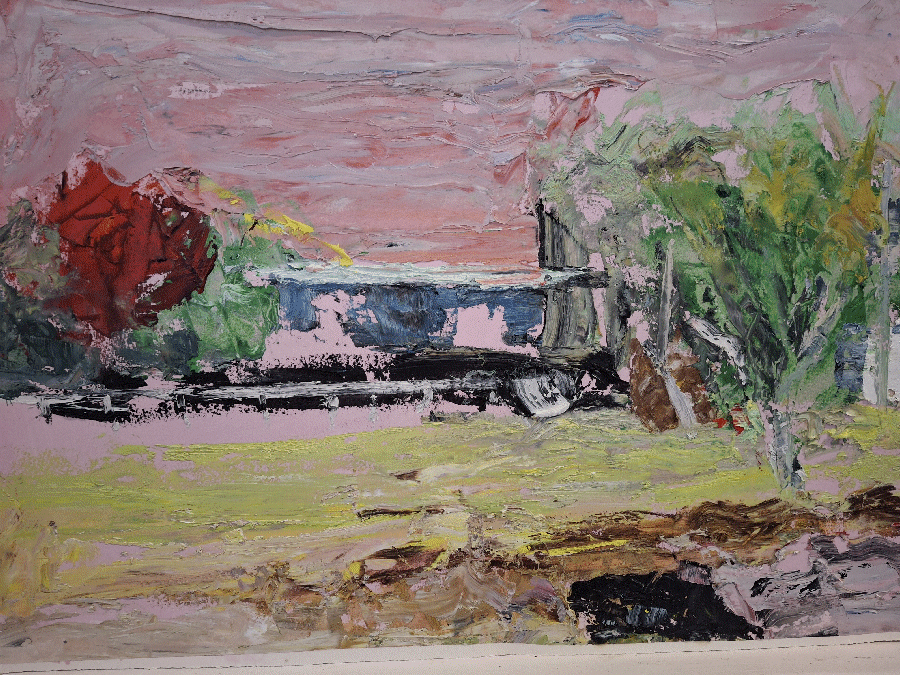 Jelle van den Berg and his Man Mountain exhibition (sample above) is on in God's Waiting Room (the church hall) today alongside the museum. This is its last opening.
♦♦♦♦
It is also National Tree Day and also the last market day for the next couple of months as winter starts to set in. The Big Morning Tea is on in downtown Murrurundi's CTC while over in the church (Anglican) there is a celebration thanksgiving service for the ministry of Rev Barbara Morgan and a blessing service for the St Paul's Memorial Meditation Grove at 10:00 (and lunch in the grove). There is also a memorial talk to commemorate Charlotte Drake-Brockman's artistic contribution to the region at Fran Wachtel's barn on Sunday at 2pm. Get some of the good stuff today because the ice cream shop alongside the CWA closes today for a three-month winter break.
♦♦♦♦
NEWS:
🚇
So much
for locals
buying
Aussie-made
The national Anti-Dumping Commission has upheld a preliminary finding that Hunter manufacturer Molycop had suffered material injury
from the importation of cheap Chinese train wheels, reports the Newcastle Herald website today. [click to read more]
The ADC released its statement of essential facts about the case as part of its investigation on Friday.
It followed a preliminary determination made in December, where the commission proposed placing a 36.9% duty on imported Chinese wheels.
The ADC began investigating the matter last year after Molycop alleged it was being commercially crippled by the volume of Chinese-made freight wheels hitting the Australian market.
Local manufacturers previously supplied all railway wheels for the state’s trains, however, this has fallen to less than 30%.
In addition to millions in lost earnings, Molycop cut 250 jobs in September 2023 due to the impact of dumping.
It is now consulting with its workforce about the potential loss of another 11 jobs.
In its most recent update, the ADC said there was no question that imported goods competed directly with domestically-produced products.
Customers typically procure freight railway wheels through long-term supply contracts or tender agreements, which set pricing and supply quantities for a defined period. In negotiating these contracts, price is the material factor in the purchasing decisions of customers.
Its analysis found imported train wheels were generally priced below Comsteel’s prices during the investigation period (July 1, 2024 and June 30, 2025).
The commissioner preliminarily considers that dumping and subsidisation by Chinese exporters resulted in them providing goods to customers in Australia at prices that were lower than if they were not dumped or subsidised,
the report said.
“If the prices of imported goods are adjusted to compensate for the applicable dumping and subsidy margins, i.e. to a 'remedied price', they closely match Australian industry prices.
The commissioner considers that in this situation, Australian industry prices would be competing on 'a level playing field', in which the Australian industry would be unlikely to be experiencing price injury.
The commission is due to hand down its final report by August 14.
Ed: Nice of local companies to support Australian-made and nice of Albo to step in!!!!!
[click the intro to return to front page]

💲
Drone
show given
the flick
Vivid has officially pulled the plug for good on its famous light show after haywire drones plummeted from the sky in masses, reports the news.com.au website today. [click to read more]
Almost 90 drones plummeted into Sydney Harbour during Sydney’s Vivid Festival earlier this week, forcing organisers to cancel the show due to unforeseen technical issues
.
A fleet of colourful drones light up the sky around Cockle Bay in Darling Harbour during the early ’star-Bound' show at 7.30pm, before 89 drones began breaking away from the pack and plummeting into the water below.
In one video shared online, rogue drones can be seen separating from the group before one loudly splashes into the water as spectators gasp.
Vivid Sydney was forced to cancel the later 9.30pm show on Monday, with the Tuesday and Wednesday night shows also cancelled to allow for a full assessment,
according to a Vivid Sydney spokesperson.
Now, following a full assessment, Vivid organisers have revealed the remaining drone shows will not proceed, citing public safety and technical advice.
We understand this will be disappointing for audiences and appreciate the public’s understanding,
they organisers wrote online.
Fireworks displays will now complement the Laser Lightfall experience in Darling Harbour at the times previously scheduled for drone shows, adding another layer of spectacle to Vivid Sydney’s celebrations.
Singaporean organisers ’skyMagic', which purports to be the world’s leading drone light show company, said the issue was caused by an unforeseen change in the radio frequency
environment after takeoff.
This anomaly caused a number of drones in the fleet to enact failsafe landing procedures in response to compromised positional accuracy,
it said in a statement.
The pilot team encountering the issue immediately performed a stop command rendering the fleet stationary in the air, enabling time to safely assess the issue. Once stability had been evaluated, the team then activated the return to home protocol bringing the unaffected drones to a safe landing.
Some vehicles during the emergency landing phase encountered the geofence boundary and shut down to preserve the safety zone resulting in them falling into the water.
SkyMagic claimed the issue did not occur during testing, rehearsal or pre-flight checks performed immediately before takeoff, and claimed no drones escaped the safety boundary of the show parameters.
However, speaking to the ABC, an anonymous worker said they saw the drones crashing
into the marina wharf and almost hitting some workers.
[click the intro to return to front page]
🍱
Storms
in the
teacups
Claims have emerged that ISIS-linked women who landed in Sydney this week received taxpayer-funded 'VIP treatment', including a pizza dinner, the Daily Telegraph newspaper reports today.
Police and government sources have told The Saturday Telegraph of undisclosed details pointing to an alleged overuse of police resources, including the public order and riot squad in a bid to avoid a media circus".
One police source said riot police were called at 3pm on Tuesday - a mere two hours prior to the cohort of four women and their children landing at Sydney Airport.
Someone in the government panicked,
a police source said.
They were never a threat, nor was there profile of a threat … the government were spooked that there would be a media circus at the airport like the ugly scenes in Melbourne.
Speaking on claims the ISIS-linked cohort were fed pizza, the police source said they got fed and we didn't".
A federal government source, who spoke on condition of anonymity, said it was ridiculous
the group received VIP treatment
upon their arrival.
It sets a precedent that you can willingly travel to a declared terrorist zone run by Islamic State and come back with a red carpet rolled out for you from a side exit,
the source said.
Meanwhile, the concerted bid to conceal which official or department was responsible for the welcome mat
reception of the women has become so farcical, the NSW Department of Communities and Justice even declined to answer questions about whether it paid for a pizza delivery to a hotel in Mascot for the group after their arrival on Tuesday evening.
The Saturday Telegraph has confirmed these events with three separate sources.
Departmental workers had assisted the women and children upon landing with an almost three-hour health assessment, before they were whisked away in government cars to the hotel.
Any access to government services is assessed in line with the same eligibility requirements that apply to other Australian citizens,
a spokeswoman said.
“NSW has well-established arrangements in place to manage any returnees, with community safety as the overriding priority.
These arrangements were successfully implemented in previous repatriations under former governments.
But Federal Opposition Leader Angus Taylor claimed these individuals chose to abandon Australia, to travel to terrorist hot spots, to support one of the world’s most evil death cults, and to steep their children in a monstrous ideology
.
Brian Marlow, founder of Revive Australia and former president of the Australian Taxpayers' Alliance, is running a grassroots campaign alongside political activist Drew Pavlou calling to deport the ISIS brides
.
The petition has gathered more than 4000 signatures.
Even if people weren't struggling in record numbers, the idea that taxpayers would foot the bill for these people is atrocious,
Mr Marlow said.
On Thursday, the AFP charged alleged Victorian ISIS supporter Rayann Elhouli, who returned from the al-Hawl detention camp in northeast Syria in September.
[click the intro to return other stories]
💲
Borrowing
just got
dearer folks
Australians could soon be paying more for their mortgages as a major bank offers an insight into what’s coming next
for interest rates, reports the news.com.au website today. [click to read more]
National Australia Bank has become the first of the major banks to lift rates in the weeks after May’s official cash rate hike.
NAB has lifted fixed rates for its one and two-year mortgages by 15 basis points.
Its lowest fixed rate mortgage is now 6.49%.
Canstar data insights director Sally Tindall fixed rates were often a window into what banks thought was coming next.
NAB’s decision to lift its short-term fixed rates suggests it’s not ready to rule out further rate rises, even though the RBA will almost certainly hit pause next month,
she said.
National Australia Bank has become the first of the major banks to lift rates in the weeks after May’s official cash rate hike.
NAB has lifted fixed rates for its one and two-year mortgages by 15 basis points.
Its lowest fixed rate mortgage is now 6.49%.
Fixed rates were often a window into what banks thought was coming next, Canstar data insights director Sally Tindall said
NAB’s decision to lift its short-term fixed rates suggests it’s not ready to rule out further rate rises, even though the RBA will almost certainly hit pause next month,
she said.
But the all-important trimmed mean inflation rate ∼ which the RBA watches because it strips out volatile and seasonal items ∼ rose to 3.4% for the 12 months to April, showing underlying price pressures are still in the Australian economy.
Both numbers are still well above the RBA’s inflation target of between 2-3%.
Borrowers hoping for a reprieve will be waiting for a while. The reality is, rates are likely to remain high for the foreseeable future and could well get one or two notches tighter,
Ms Tindall said.
Even after back-to-back cash rate hikes, Australia’s mortgage market continues to barrel ahead, with the total value of housing loans hitting yet another record high.
Canstar says outside of the major four banks, the lowest fixed rate is now 5.99% available for both a one and two-year term.
Competitive fixed rates are fast becoming a thing of the past. At the start of the year there were 83 lenders offering at least one fixed rate under 6%. Today there are just three,
Ms Tindall said.
[click the intro to return to front page]
🌄
Cancer
patients
get chemo
reprieve?
Groundbreaking genomic test could spare millions of breast cancer patients chemotherapy. Trials suggest patients with a low test score could be treated with hormone therapy alone with near-identical outcomes writes The Guardian website. [click to read the rest of the story].
Millions of women with breast cancer could be spared chemotherapy with a groundbreaking genomic test, according to the results of a trial that could transform healthcare guidelines worldwide.
Treatment for breast cancer, the world’s most prevalent form of the disease, involves surgery to remove tumours. Chemotherapy is then usually recommended when doctors believe there is a risk the disease will return.
But chemotherapy’s toxic side-effects, which can include hair loss, rashes, nausea, insomnia and fatigue, are physically and emotionally gruelling for patients. Some women may face life-changing consequences such as infertility, cognitive impairment or early menopause.
For decades, there has been little choice for patients. Now scientists have developed a genomic test that can spot who needs chemotherapy and who doesn't. The breakthrough enables doctors to determine which patients can safely skip it, paving the way for a new era of personalised medicine.
Results from an international trial of the test suggest millions of women could safely avoid chemotherapy, sparing them side-effects without increasing the risk of their cancer returning. The findings will be presented at the world’s largest cancer conference, the American Society of Clinical Oncology’s annual meeting, in Chicago today.
The Optima trial, led by University College London, followed more than 4000 patients with newly diagnosed breast cancer in the UK, Norway, Sweden, Australia, New Zealand and Thailand. It found that those with a low score on the genomic test could be treated safely with hormone therapy alone.
One woman who took part in the trial told the Guardian that being able to skip chemotherapy felt like Christmas
. Nine years after being diagnosed, taking the test and skipping chemotherapy, she is healthy and enjoying a full and active life.
Optima addresses a longstanding challenge in breast cancer care: identifying who truly benefits from chemotherapy and who does not. Our findings show that many patients can safely avoid chemotherapy without compromising their outcomes,
Rob Stein, the trial’s chief investigator and a professor of breast oncology at UCL, said,
“These results mark an important and significant step toward more personalised treatment. The trial has successfully used tumour biology to guide decisions rather than relying solely on traditional clinical features.
For patients, this means many may be spared the physical and emotional burden of chemotherapy and its potential long-term side-effects. For health systems, it represents a more efficient and evidence-based use of resources.
The Prosigna test, made by the global diagnostics company Veracyte, analyses the activity of 50 genes in tumour tissue. It determines the molecular subtype and provides a score revealing the risk of breast cancer returning in the next decade, helping doctors decide if chemotherapy is worthwhile or not.
[click the intro to return to front page]
COMMENT:
Murrurundi Times news site with items covering national news and Upper Hunter region including the township of Murrurundi
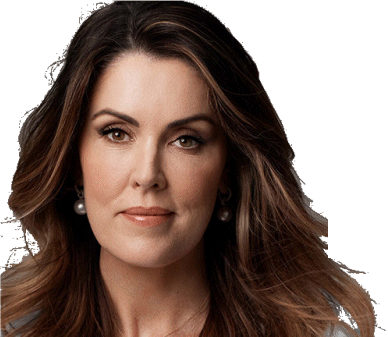
Federal Court has ruled against a women-only app founder in a landmark transgender discrimination case, forcing her to pay compensation and sparking fears about women’s rights, writes Peta Credlin in the Sunday Telegraph today. [click to read more]
On Friday afternoon, as I sat down to work on this column, I honestly didn't know where to focus first.
Was the biggest issue the loss of integrity in our public life, after the Prime Minister ("my word is my bond") admitted saying 50 times he would not change any of the rules around investment properties but did it anyway?
Or was it the reality, confirmed in the budget papers, that under Labor’s record high immigration, Australia will hit 30 million people by 2030, despite nowhere near enough housing for those here now? Or was it the revelation that Labor has just brought in death duties by stealth?
Giggle v Tickle
As I debated all of this, the Federal Court handed down its decision in the long-running Giggle v Tickle case, where Sall Grover, a woman and founder of a women’s online networking app (called Giggle For Girls) was accused of discrimination against a transgender woman, the biologically male Roxanne Tickle, who sought to join the women-only app.
In a devastating blow for the rights of women and girls in this country, the court rejected scientific fact and declared that sex was more than biology (it isn't), and so Grover lost and now owes compensation to Tickle.
The fact that the taxpayer-funded Human Rights Commission was a part of this legal action to deny all women our biological rights is appalling. The fact that Grover now has to rely on donations from ordinary people to defend rights that should not need defending says everything about the state of woke policy and activist courts in Australia.
But what’s perhaps most galling of all is that we are only in this position of denying chromosomal reality because Julia Gillard, ironically the first female prime minister, stripped the word woman
from the sex discrimination act. Before then, this case would never have got to court.
Anyone for any toilet
But what this latest decision does (and let’s hope it gets overturned when Sall Grover heads to the High Court), is that women’s sport, toilets, access to medical services, schools, clubs, domestic violence shelters, prisons ∼ the whole box and dice ∼ are open slather to any man who declares he is a woman.
Gender used to be what you called yourself, sex is what XY or XX made you. Not any more, thanks to this decision. And Gillard too, who changed the law just TWO DAYS before she was rolled by Kevin Rudd in June 2013 — how dare she lecture anyone on misogyny.
But on Friday afternoon, the bad news kept coming.
To add Labor insult to Labor injury, dropped out when they hoped no-one was watching was news from the Victorian government that not only was Daniel Andrews going to get a bronze statue in his honour but that it was already being made. You can't make this stuff up, can you?
In memory of stupidity
Given Victoria has a daily interest bill of $24 million, a $130,000 statue is a rounding-error but it’s the attempt to force Victorians to honour the man who locked them up for two years, ruined businesses, blew out debt, kowtowed to China, dialled up woke and made the once-proud state an international laughing stock that’s tipped people over the edge.
Am I the only one asking how the heck did we get here?
And, more to the point, how do we turn it around or, God forbid, is it even possible?
Never trust any leader again
If Albanese is allowed to get away with his massive budget lie, then we will never be able to trust any leader again. And if we can't ask questions before an election and base our decisions on what they tell us and hold them to it, then democracy is dead.
For all of Labor’s talk about intergenerational equity, the budget hits younger Australians the hardest. The PM says breaking his word on negative gearing is about them, but how can it be when they will never be able to use negatively gearing (as he has) to build up a nest egg but those doing it now can keep it up?
Buy a new-build property instead, Labor tells investors. But again, how’s that fair for young people given this is what they typically buy as a first home and, now, they're going to face even more competition as investors move in? Even Labor’s own budget papers admit that these changes will likely increase rents (as they did in the Keating era before he was forced to back down) and do little to increase the stock of available homes.
And then there’s the tax on aspiration (CGT changes) before they get you from the grave (the hit on trusts).
Liberal backbone
Thankfully, the Liberals have finally found a bit of policy backbone, and a bit of political mongrel.
Angus Taylor’s reply to Labor’s budget speech felt like the start of the Coalition getting its mojo back. He made the bold move to end bracket creep once and for all by indexing income tax thresholds, meaning low- and middle-income earners won't get punished for getting ahead. On migration, he went for the jugular and landed a bullseye if the hyperventilating from Labor MPs is any guide. The PM in particular was hysterical, declaring it was un-Australian to divide people between those who are migrant and those who are not.
That is not what Taylor did. He divided them between Australian citizen and non-citizen and said that, under the Coalition, only citizens would get access to the pension, the dole, the NDIS and other welfare.
Help for no commitment
Now what is unfair about that? Why should your taxes carry people who have made no formal commitment to this country? Right now, people can live here for decades, take the money and never pledge loyalty to Australia and its people. Taylor says not any more.
Add in the Treasurer’s announcement of a new Working Australians Tax Offset (a pollster-named handout if ever there was one) of $250 a year (or $4.80 a week) and rightly people are angry. In his budget speech, Jim Chalmers called his WATO meaningful
but what’s meaningful about 68 cents a day when the cost of everything has skyrocketed? It’s not meaningful, it’s insulting.
(And I might add, it’s still not even the $275 Albanese promised off their power bills).
Albo's right for a change
Anthony Albanese said that this budget is full of Labor values
and it is — the socialist values
that attack the fair-go, break trust, and hit middle Australia even harder
For the Liberals, there could be no better ground than this to fight Labor.
If the Coalition holds its nerve and campaigns every day like its life depends on it (because, frankly, it does) then this budget could well be the beginning of the end for the Albanese government.
But only if they work, day and night, to take the fight up to Labor. Labor is the target, not each other and not One Nation.
THUMBS UP
Jacinta Nampijinpa Price: Her emotional, fighting speech in the Senate is a must-watch as she demanded culture
takes a back seat to better protect Aboriginal children.
THUMBS DOWN
Military witch hunt: Another $43m in Labor’s budget to investigate soldiers on top of the $350m that the Brereton process has cost taxpayers already.
Murrurundi Times news site with items covering national news and Upper Hunter region including the township of Murrurundi

Al Gore's An Inconvenient Truth, released 20 years ago this week, was an extraordinary cultural phenomenon. Honoured by the Norwegian Nobel Committee as the work of "the great communicator", the film rapidly acquired immense authority, Henry Ergas reminds in the The Australian today. [click to read more]
Yet with so many of its dramatic predictions in tatters, the question is no longer whether the film was right or wrong. It is how a misleading narrative acquired such power that it helped make economic self-harm the West’s supreme moral virtue.
The great thinkers of the Enlightenment would have viewed the spectacle with disbelief. Reason’s march, wrote John Trenchard and Thomas Gordon in Cato’s Letters, was sure to expose the ravings of Oracles and Seers
as idle and superstitious Fables
.
And by daring to know
, added Immanuel Kant, mankind would be released from its self-imposed tutelage
to falsehoods, submitting every claim to remorseless examination.
Disappearance of human credulity
Transferring that emancipatory promise from philosophy to science, the 19th century displayed even greater confidence in the disappearance of human credulity. The unveiling of nature’s laws, said Auguste Comte, would inaugurate a religion of humanity
that worshipped the scientific method. Freed from the false methods of metaphysics
, the human mind would at last possess the key to the truth
.
Yet the 19th century’s cult of science hardly banished the supernatural. It merely recast it in scientific form. Even as philosophers proclaimed rationality’s triumph, spiritualism swept the West, with mediums and seances presented as science’s latest frontier. The age that marvelled at electricity and the telegraph proved equally eager to drape mystery in the rhetoric of experiment, observation and empirical verification.
Nor were the period’s most eminent scientists immune to mystery’s lure. Among spiritualism’s ardent defenders were Alfred Russel Wallace, co-discoverer with Charles Darwin of natural selection, and distinguished physicist Oliver Lodge.
Its advocates also included such formidable leaders as William Gladstone, Alfred Deakin, Stanley Baldwin and Canada’s greatest 20th-century prime minister, William Mackenzie King, whose conversations with Franklin D. Roosevelt reportedly continued long after Roosevelt’s death.
Spiritualism’s delusions
But spiritualism’s delusions were comparatively benign, comforting millions of bereaved parents and widowers. It was Marxism that proved to be the most catastrophic product of the 19th century’s gifting of scientific authority to myth.
Marxism’s claims were vast. As Engels declared at Marx’s graveside in 1883, his friend had achieved for society what Darwin had achieved for nature — the discovery of history’s law of development
, whose unfolding was as inevitable as a law of physics. But Marxism went even further, combining scientism with 19th-century Romanticism’s apocalyptic imagination.
Marx had said that capitalism would be shaken
(erschüttert) by its mounting contradictions; when editing Das Kapital’s third volume, Friedrich Engels changed it to collapsed
(zusammengebracht). Capitalism’s destruction was a scientific certainty, he claimed, for it was racing to ruin like a locomotive whose jammed safety valve the driver is too weak to open
.
From this emerged Marxism’s moral absolutism. Apocalyptic visions had long envisaged a final struggle between the forces of God and the forces of Satan; Marxism translated that struggle into secular form.
Noxious bourgeois vermin
Those who opposed scientific socialism
were worse than merely mistaken: by breaking the higher law of history, they became enemies not just of the proletariat but of humanity. The distance from that to Lenin’s demand for the extermination of noxious bourgeois vermin
was alarmingly short.
It was that same moral and psychological absolutism that resurfaced, long after communism’s collapse, in the secular religion proclaimed by An Inconvenient Truth. But its apocalypticism, although also clad in scientific garb, does not belong to the 19th century’s rationalist certainties; it comes suffused with the Middle Ages' prophetic terrors.
Medieval apocalypticism was, for example, obsessed with dating the end times. Joachim of Fiore determined that the Antichrist would appear after 42 generations of 30 years, while Pope Innocent III’s Quia maior performed elaborate numerological exegeses upon the Beast’s number, 666.
Climate discourse’s own numerology mirrors that obsession: 12 years
, eight years
, 1.5 degrees
, 350 parts per million
, net zero by 2050
. Each figure is freighted with the urgency of revelation and the authority of numerical precision — only to be quietly superseded when the appointed hour passes uneventfully.
Just renew the countdowns
Failed prophecies, Richard Landes showed, didn't destroy medieval apocalyptic movements; they intensified them as the deadline was recalibrated. So too with the ever-contracting windows to climate catastrophe, every expiration yielding not disillusionment but a new countdown, a new threshold and a new call for repentance.
In exactly the same way, medieval apocalypticism divided the world into the children of light and the children of darkness. Those who doubted the end-time’s imminence were Satan’s keepmates; those who questioned its numerological proofs were the bastard offspring of the Antichrist.
Climate discourse reproduces this structure. Sceptics are not people who need to be convinced; they are deniers
— a term calculated to demonise them with the moral infamy of Holocaust denial. Rather than meriting a serious reply, they have to be mercilessly exposed as the malign agents of self-interest.
But the consequences of this Manichean outlook, with its demand for an embodiment of absolute evil, are graver yet. The apocalyptic movements of the 12th century drew an ever-tighter circle around the elect, expelling from the community of the saved heretics, schismatics and, above all, Jews — whose continued existence figured in the eschatological imagination as a fatal obstacle to the coming of the heavenly kingdom.
Climate activists' sense of fury
From this sprang an uncontrollable rage that all too readily transmuted into violence.
The climate activists share that sense of fury; what lends it still greater intensity is that fury is almost all they possess.
Medieval apocalypticism held out the promise of a Beautiful Ending: the millennium, the reign of the saints, the New Jerusalem. Marxism preserved that structure: the dictatorship of the proletariat would culminate in eternal abundance.
But in climate catastrophism, the utopian horizon has withered away. And because the positive vision is so threadbare, while the visions of devastation are so overwhelming, the movement’s emotional grammar is saturated with rage: rage at those who refuse to submit, rage at those who continue to doubt, rage at those who stand in the way.
Little wonder climate activists deride democracy. Instead of medieval apocalypticism’s Beautiful Ending, climate catastrophism offers only Dutiful Compliance — the insistence, echoing Marxism, that humanity can be saved solely through obedience to science’s supposedly inexorable laws, as interpreted by its infallible prophets.
The science is in; the messy trade-offs that are democracy’s way of managing complex and contentious issues are out — with raising them akin to apostasy.
These are, in other words, true fanatics, willing, in Voltaire’s words, to inundate the world with blood for the sake of unintelligible sophisms
. That the Greens can be climate extremists one day and admirers of Hamas’s death cult the next is therefore hardly surprising.
Therein, 20 years later, lies the tragedy. Science hasn't killed apocalypticism or curbed its dangers; it has merely dressed the apocalyptic delusions in new robes. And the civilisation that believed it had escaped the ravings of Oracles and Seers
has ended by canonising them anew — with Al Gore as their most enriched and exalted evangelist.
FEATURE:
OVERSEAS:

Pro-war pop star Shaman's latest music video shows AI deepfakes of exiled anti-war celebrities singing the chorus: "Mother Russia, you're in my heart, you're the only one, with you until the end." Photo: Shaman/VK
The Moscow Times writes Armenia's relationship with Russia is a complicated one. Despite Yerevan's anger over Moscow's failure to stop Azerbaijan's takeover of Nagorno-Karabakh in 2023, Prime Minister Nikol Pashinyan was still on good enough terms with the Kremlin to attend the 2025 Victory Day parade on Moscow's Red Square. Barely a year later, Russia evidently feels spurned by Yerevan as it has moved closer to Europe and further from the Kremlin's orbit. Armenia has frozen its participation in a Russia-led defense alliance and in early May hosted a European Political Community summit attended by Ukraine's President Volodymyr Zelensky. Yet Armenia remains heavily dependent on Russia economically — a fact that Moscow appears increasingly willing to exploit. This week, Russia moved to restrict imports of Armenian agricultural products, wine, cognac and mineral water and threatened to scrap a 2013 agreement guaranteeing duty-free gas and oil to the South Caucasus country. ■ This pressure comes weeks before Armenians go to the polls on June 7. International observers warn that Russia could seek to influence the outcome, especially as several opposition figures are seen as favoring closer ties with Moscow than Pashinyan's government. What else happened this week ■ Russia's attempt to deliver fuel to crisis-hit Cuba hit a setback after a sanctioned tanker failed to reach the island, spending weeks drifting in the Atlantic Ocean instead. ■ Putin signed a law to forgive up to $140,000 of debts for new contract soldiers and their spouses as Russia struggles to recruit more men for its Armed Forces. ■ Russia introduced enhanced health screenings for travelers arriving from African countries hit by a deadly Ebola outbreak. Rospotrebnadzor said it deployed teams of Russian scientists to Uganda, the DRC and Burundi to help combat the spread of Ebola, including by providing testing systems. ■ Two people were wounded after a Russian drone crashed into an apartment building in Romania. Bucharest said the incident was a "serious and irresponsible escalation" from Moscow and asked NATO to speed up delivering anti-drone systems to protect the country. ■Russia failed for a second time to auction the country's third-largest gold company, which was confiscated from regional lawmaker Konstantin Strukov last July. The only interested buyer was ultimately disqualified for unclear reasons. ■ A Moscow woman was sentenced to three years in prison for making a hookah out of a traditional kulich Easter cake, while a manager from The Walt Disney Company was sentenced to 2.5 years in prison after he was found guilty of drug possession and smuggling.
Created by DiDa - http://www.faico.net/dida/
-
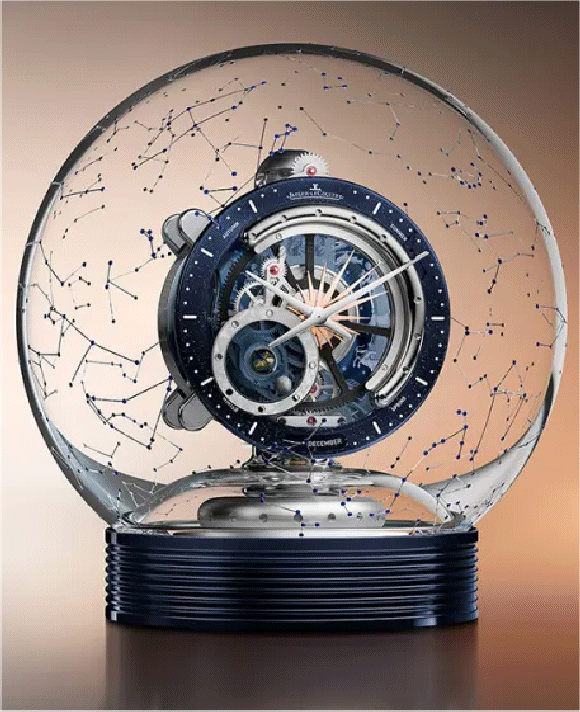
The tik-toks have it
At Milan Design Week, just following Watches and Wonders, Jaeger-LeCoultre staged The Perpetual Timekeeper, a sprawling two-floor exhibition dedicated not to wristwatches, but to Atmos clocks-the mysterious, glass-encased objects that have quietly occupied one of the most intriguing corners of the maison's history since 1928. ROBB Report.
-
Powerhouse art work
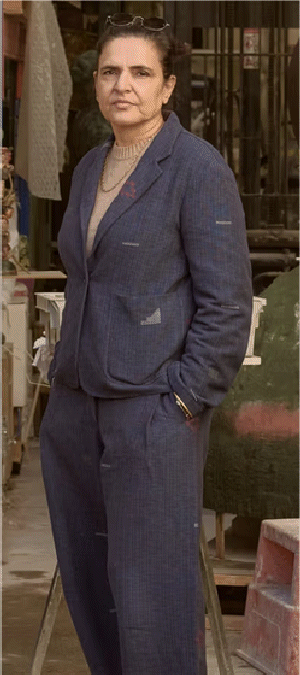
British Indian artist, 57-year-old Bharti Kher, has been commissioned by Powerhouse Parramatta to create a large-scale public artwork for the forthcoming museum, which is slated to open later this year in Parramatta, Western Sydney. Titled Tree of Life, Kher's project is a seven-meter-tall, totem-like bronze sculpture of fourteen heads stacked atop one another, encapsulating themes of ancestral memory, interconnectedness, and community, reports artasiapacific.com
The Murrurundi Times is owned, compiled and written by Des Dugan. Email
Wall Street’s main indexes hit record closing highs on Friday and posted weekly and monthly gains as Dell results drove tech shares higher, while investors awaited details on a potential U.S.-Iran deal, Reuters reports on today's website. [click to continue reading]
President Donald Trump said in a social media post that he would make a final decision on the Iran deal on Friday. Tehran earlier said it was looking for action, not words, when it came to an agreement.
Dell surged 32.8% after raising its full-year profit and revenue forecasts on Thursday. The tech sector climbed 1.87%, fueled by gains in chip stocks.
Peers Hewlett Packard Enterprise and Super Micro Computer gained 12.6% and 11.6% respectively. Microsoft climbed 5.4%.
The software services index also advanced by over 6%, erasing all losses since January-end, when concerns over AI disruption had weighed on the sector.
Earlier in the session, all three indexes hit intraday record highs, cruising on renewed optimism around AI and strong earnings growth, despite concerns about the Iran war’s impact on inflation and the global economy.
The Dow Jones Industrial Average rose 363.37 points, or 0.72%, to 51,032.34, the S&P 500 gained 16.44 points, or 0.22%, to 7,580.07 and the Nasdaq Composite 55.15 points, or 0.21%, to 26,972.62.
The small-cap Russell 2000 index was down 0.6%.
For the week, the S&P 500 gained 1.43%, the Nasdaq rose 2.39%, and the Dow climbed 0.9%. The Russell 2000 index rose 1.72%.
For the month, since April 30, the S&P 500 gained 5.15%, the Nasdaq rose 8.36%, and the Dow climbed 2.78%. The Russell 2000 index rose 4.24%.
The S&P 500 registered its ninth consecutive weekly gain, its longest winning streak since December 2023.
There’s definitely euphoric sentiment in the market around AI. The rally has really been driven by earnings,
said Ohsung Kwon, chief equity strategist at Wells Fargo.
He suggested investors buy and hold AI stocks, then earn extra income by selling call options at prices much higher than the current stock price.
Melissa Brown, head of investment decision research at SimCorp, said over the past few weeks volume has gone up, which suggests more people are coming into the market.
The S&P 500 communications services sector dropped, as Alphabet declined by 2.5%.
Consumer staples shares were weak, with heavyweights Costco and Walmart down 3.9% and 2.6% respectively.
The S&P automaker index dropped after reports the Trump administration wants North American-built vehicles to have 82% regional content to qualify for preferential treatment under the U.S.-Mexico-Canada Agreement.
Shares of General Motors fell 1.3% and U.S.-listed shares of Stellantis dropped 2.7%.
U.S. economic data on Thursday showed inflation increased at its fastest pace in three years in April, while GDP for the first quarter was revised lower to a 1.6% annual rise.
The Fed’s Kansas City president Jeffrey Schmid warned the energy shock may not be temporary. Vice chair for Supervision Michelle Bowman said a persistent rise in inflation might require tighter monetary policy.
Money markets expect the Federal Reserve to keep interest rates steady for the rest of the year, with expectations of a 25-basis-point hike in December.
Among other movers, Gap shares tumbled 15.4% after the apparel retailer cut its annual sales forecast, while American Eagle Outfitters dropped 11.8% after keeping its annual comparable sales forecast unchanged.
Declining issues outnumbered advancers by a 1.04-to-1 ratio on the NYSE. There were 491 new highs and 102 new lows on the NYSE.
On the Nasdaq, 2,378 stocks rose and 2,486 fell as declining issues outnumbered advancers by a 1.05-to-1 ratio.
The S&P 500 posted 27 new 52-week highs and 12 new lows while the Nasdaq Composite recorded 125 new highs and 54 new lows.
Volume on U.S. exchanges was 23.9 billion shares, compared with the 19.36 billion average for the full session over the last 20 trading days.
| 🌿 | Killing a few more than weeds |
Paraquat was hailed as a wonder poison for Australian farmers but 60 years since its introduction, those stricken with parkinson’s disease are counting the cost, reports The Australian today's website. [click to read more]
Kevin Treeby is a man of soil and sweat and simplicity. A lifetime’s farming has left his face leathered, his palms calloused. His body has grown used to the repeated frictions and irritations of working his land, encouraging crops to grow. Spring after spring in WA’s remote Gairdner River region, six hours' drive southeast of Perth, Treeby planted 1400ha of wheat and barley while raising his three children with his wife of 52 years, Jenny.
Never did he imagine that a toxic herbicide, paraquat ∼ the weedkiller of choice for grain farmers across the country ∼ may have sown the seeds of his own destruction.
Kevin Treeby has been diagnosed with parkinson’s disease. He is far from alone in Western Australia’s fertile wheatbelt and Great Southern regions, where parkinson’s is ravaging farmers in numbers that suggest a previously unidentified cluster of the disease. While there is a scarcity of hard data on cases in Australia, statistics published by Parkinson’s Australia estimate the wheatbelt has as many parkinson’s sufferers as inner Perth, where there is three times the population. Epidemiologists have studied similar Parkinson’s hotspots in regional Victoria, while the disease is also prevalent in pulse crop farming communities on the NSW mid north coast and in rural Queensland.
The question is why?
Like most of the farmers stricken with this incurable neurological disorder in later life, Treeby has no genetic predisposition to parkinson’s, no family history. He is convinced his illness has been triggered by toxic chemicals he’s worked with over a lifetime in agriculture.
In the 1970s we just accepted we had the best herbicides on the market and no one told us any different,
he says. I strain to catch his soft, breathy voice, a hallmark of parkinson’s. You could taste the chemicals in the back of your throat. I'd physically recoil from the smell. The weedkiller stunk to high heaven. Yet there were no rules about spraying. No gloves, no masks … you'd eat your morning tea with your hands coated in spray. Lots of farms around us aerial-sprayed so we got a lot of drift too.
Among the most noxious of these chemicals was paraquat, enthusiastically embraced for decades by Australian farmers for its potency. paraquat was very effective and very popular,
says Treeby.
Everyone we knew was using it.
His voice trails off. Wife Jenny fills the silence as his gaze wanders to the window. Once upon a time in the country, you hardly knew anyone with parkinson’s,
she says.
Now you see old farmers with parkinson’s all the time. You can pick them out in town, the way they walk, dragging their feet along the ground. They're not swinging their arms, they just shuffle along. We'll point them out and say, 'Betcha that guy’s got parkinson’s,' or 'There’s something wrong with that fella.' It’s always parkinson’s.
Worldwide, deaths caused by parkinson’s have soared this century, with numbers increasing by 100% since 2000, according to the World Health Organisation. Globally, it is now the fastest growing neurological disorder, second only to dementia. It’s a progressive, debilitating disease for which there is no cure.
The concentration of parkinson’s cases among older farmers across the globe has led to a body of medical research scrutinising the link between pesticide exposure and the disease. In terms of paraquat, that link ∼ described as substantial
by the journal Parkinsonism and Related Disorders ∼ has given rise to a tide of litigation overseas and bans in 74 countries.
Australia is not one of them.
Australia and the US has remained the outliers among developed nations, keeping paraquat legal but under regulatory review for decades. Despite evidence of a link to parkinson’s ∼ including leaked documents dating back to some of the earliest clinical studies on paraquat ∼ domestic agencies in both countries have been in lockstep with Syngenta.
The chemical giant insisted the product was safe to use as —directed, while at the same time settling legal action from farmers in the US before cases could go to trial.
♦♦♦♦
It is also National Tree Day and also the last market day for the next couple of months as winter starts to set in. The Big Morning Tea is on in downtown Murrurundi's CTC while over in the church (Anglican) there is a celebration thanksgiving service for the ministry of Rev Barbara Morgan and a blessing service for the St Paul's Memorial Meditation Grove at 10:00 (and lunch in the grove). There is also a memorial talk to commemorate Charlotte Drake-Brockman's artistic contribution to the region at Fran Wachtel's barn on Sunday at 2pm. Get some of the good stuff today because the ice cream shop alongside the CWA closes today for a three-month winter break.
♦♦♦♦
| 🚇 | So much for locals buying Aussie-made |
The national Anti-Dumping Commission has upheld a preliminary finding that Hunter manufacturer Molycop had suffered material injury
from the importation of cheap Chinese train wheels, reports the Newcastle Herald website today. [click to read more]
The ADC released its statement of essential facts about the case as part of its investigation on Friday.
It followed a preliminary determination made in December, where the commission proposed placing a 36.9% duty on imported Chinese wheels.
The ADC began investigating the matter last year after Molycop alleged it was being commercially crippled by the volume of Chinese-made freight wheels hitting the Australian market.
Local manufacturers previously supplied all railway wheels for the state’s trains, however, this has fallen to less than 30%.
In addition to millions in lost earnings, Molycop cut 250 jobs in September 2023 due to the impact of dumping.
It is now consulting with its workforce about the potential loss of another 11 jobs.
In its most recent update, the ADC said there was no question that imported goods competed directly with domestically-produced products.
Customers typically procure freight railway wheels through long-term supply contracts or tender agreements, which set pricing and supply quantities for a defined period. In negotiating these contracts, price is the material factor in the purchasing decisions of customers.
Its analysis found imported train wheels were generally priced below Comsteel’s prices during the investigation period (July 1, 2024 and June 30, 2025).
The commissioner preliminarily considers that dumping and subsidisation by Chinese exporters resulted in them providing goods to customers in Australia at prices that were lower than if they were not dumped or subsidised,
the report said.
“If the prices of imported goods are adjusted to compensate for the applicable dumping and subsidy margins, i.e. to a 'remedied price', they closely match Australian industry prices.
The commissioner considers that in this situation, Australian industry prices would be competing on 'a level playing field', in which the Australian industry would be unlikely to be experiencing price injury.
The commission is due to hand down its final report by August 14.
Ed: Nice of local companies to support Australian-made and nice of Albo to step in!!!!!
[click the intro to return to front page]| 💲 | Drone show given the flick |
Vivid has officially pulled the plug for good on its famous light show after haywire drones plummeted from the sky in masses, reports the news.com.au website today. [click to read more]
technical issues.
A fleet of colourful drones light up the sky around Cockle Bay in Darling Harbour during the early ’star-Bound' show at 7.30pm, before 89 drones began breaking away from the pack and plummeting into the water below.
In one video shared online, rogue drones can be seen separating from the group before one loudly splashes into the water as spectators gasp.
Vivid Sydney was forced to cancel the later 9.30pm show on Monday, with the Tuesday and Wednesday night shows also cancelled to allow for a full assessment,
according to a Vivid Sydney spokesperson.
Now, following a full assessment, Vivid organisers have revealed the remaining drone shows will not proceed, citing public safety and technical advice.
We understand this will be disappointing for audiences and appreciate the public’s understanding,
they organisers wrote online.
Fireworks displays will now complement the Laser Lightfall experience in Darling Harbour at the times previously scheduled for drone shows, adding another layer of spectacle to Vivid Sydney’s celebrations.
Singaporean organisers ’skyMagic', which purports to be the world’s leading drone light show company, said the issue was caused by an unforeseen change in the radio frequency
environment after takeoff.
This anomaly caused a number of drones in the fleet to enact failsafe landing procedures in response to compromised positional accuracy,
it said in a statement.
The pilot team encountering the issue immediately performed a stop command rendering the fleet stationary in the air, enabling time to safely assess the issue. Once stability had been evaluated, the team then activated the return to home protocol bringing the unaffected drones to a safe landing.
Some vehicles during the emergency landing phase encountered the geofence boundary and shut down to preserve the safety zone resulting in them falling into the water.
SkyMagic claimed the issue did not occur during testing, rehearsal or pre-flight checks performed immediately before takeoff, and claimed no drones escaped the safety boundary of the show parameters.
However, speaking to the ABC, an anonymous worker said they saw the drones crashing
into the marina wharf and almost hitting some workers.
| 🍱 | Storms in the teacups |
Claims have emerged that ISIS-linked women who landed in Sydney this week received taxpayer-funded 'VIP treatment', including a pizza dinner, the Daily Telegraph newspaper reports today.
Police and government sources have told The Saturday Telegraph of undisclosed details pointing to an alleged overuse of police resources, including the public order and riot squad in a bid to avoid a One police source said riot police were called at 3pm on Tuesday - a mere two hours prior to the cohort of four women and their children landing at Sydney Airport.
Speaking on claims the ISIS-linked cohort were fed pizza, the police source said they A federal government source, who spoke on condition of anonymity, said it was Meanwhile, the concerted bid to conceal which official or department was responsible for the The Saturday Telegraph has confirmed these events with three separate sources.
Departmental workers had assisted the women and children upon landing with an almost three-hour health assessment, before they were whisked away in government cars to the hotel.
“NSW has well-established arrangements in place to manage any returnees, with community safety as the overriding priority.
But Federal Opposition Leader Angus Taylor claimed these individuals Brian Marlow, founder of Revive Australia and former president of the Australian Taxpayers' Alliance, is running a grassroots campaign alongside political activist Drew Pavlou calling to The petition has gathered more than 4000 signatures.
On Thursday, the AFP charged alleged Victorian ISIS supporter Rayann Elhouli, who returned from the al-Hawl detention camp in northeast Syria in September.media circus".
Someone in the government panicked,
a police source said.
They were never a threat, nor was there profile of a threat … the government were spooked that there would be a media circus at the airport like the ugly scenes in Melbourne.
got fed and we didn't".
ridiculous
the group received VIP treatment
upon their arrival.
It sets a precedent that you can willingly travel to a declared terrorist zone run by Islamic State and come back with a red carpet rolled out for you from a side exit,
the source said.
welcome mat
reception of the women has become so farcical, the NSW Department of Communities and Justice even declined to answer questions about whether it paid for a pizza delivery to a hotel in Mascot for the group after their arrival on Tuesday evening.
Any access to government services is assessed in line with the same eligibility requirements that apply to other Australian citizens,
a spokeswoman said.
These arrangements were successfully implemented in previous repatriations under former governments.
chose to abandon Australia, to travel to terrorist hot spots, to support one of the world’s most evil death cults, and to steep their children in a monstrous ideology
.
deport the ISIS brides
.
Even if people weren't struggling in record numbers, the idea that taxpayers would foot the bill for these people is atrocious,
Mr Marlow said.
[click the intro to return other stories]
| 💲 | Borrowing just got dearer folks |
Australians could soon be paying more for their mortgages as a major bank offers an insight into what’s coming next
for interest rates, reports the news.com.au website today. [click to read more]
National Australia Bank has become the first of the major banks to lift rates in the weeks after May’s official cash rate hike.
NAB has lifted fixed rates for its one and two-year mortgages by 15 basis points.
Its lowest fixed rate mortgage is now 6.49%.
Canstar data insights director Sally Tindall fixed rates were often a window into what banks thought was coming next.
NAB’s decision to lift its short-term fixed rates suggests it’s not ready to rule out further rate rises, even though the RBA will almost certainly hit pause next month,
she said.
National Australia Bank has become the first of the major banks to lift rates in the weeks after May’s official cash rate hike.
NAB has lifted fixed rates for its one and two-year mortgages by 15 basis points.
Its lowest fixed rate mortgage is now 6.49%.
Fixed rates were often a window into what banks thought was coming next, Canstar data insights director Sally Tindall said
NAB’s decision to lift its short-term fixed rates suggests it’s not ready to rule out further rate rises, even though the RBA will almost certainly hit pause next month,
she said.
But the all-important trimmed mean inflation rate ∼ which the RBA watches because it strips out volatile and seasonal items ∼ rose to 3.4% for the 12 months to April, showing underlying price pressures are still in the Australian economy.
Both numbers are still well above the RBA’s inflation target of between 2-3%.
Borrowers hoping for a reprieve will be waiting for a while. The reality is, rates are likely to remain high for the foreseeable future and could well get one or two notches tighter,
Ms Tindall said.
Even after back-to-back cash rate hikes, Australia’s mortgage market continues to barrel ahead, with the total value of housing loans hitting yet another record high.
Canstar says outside of the major four banks, the lowest fixed rate is now 5.99% available for both a one and two-year term.
Competitive fixed rates are fast becoming a thing of the past. At the start of the year there were 83 lenders offering at least one fixed rate under 6%. Today there are just three,
Ms Tindall said.
| 🌄 | Cancer patients get chemo reprieve? |
Groundbreaking genomic test could spare millions of breast cancer patients chemotherapy. Trials suggest patients with a low test score could be treated with hormone therapy alone with near-identical outcomes writes The Guardian website. [click to read the rest of the story].
Millions of women with breast cancer could be spared chemotherapy with a groundbreaking genomic test, according to the results of a trial that could transform healthcare guidelines worldwide.
Treatment for breast cancer, the world’s most prevalent form of the disease, involves surgery to remove tumours. Chemotherapy is then usually recommended when doctors believe there is a risk the disease will return.
But chemotherapy’s toxic side-effects, which can include hair loss, rashes, nausea, insomnia and fatigue, are physically and emotionally gruelling for patients. Some women may face life-changing consequences such as infertility, cognitive impairment or early menopause.
For decades, there has been little choice for patients. Now scientists have developed a genomic test that can spot who needs chemotherapy and who doesn't. The breakthrough enables doctors to determine which patients can safely skip it, paving the way for a new era of personalised medicine.
Results from an international trial of the test suggest millions of women could safely avoid chemotherapy, sparing them side-effects without increasing the risk of their cancer returning. The findings will be presented at the world’s largest cancer conference, the American Society of Clinical Oncology’s annual meeting, in Chicago today.
The Optima trial, led by University College London, followed more than 4000 patients with newly diagnosed breast cancer in the UK, Norway, Sweden, Australia, New Zealand and Thailand. It found that those with a low score on the genomic test could be treated safely with hormone therapy alone.
One woman who took part in the trial told the Guardian that being able to skip chemotherapy felt like Christmas
. Nine years after being diagnosed, taking the test and skipping chemotherapy, she is healthy and enjoying a full and active life.
Optima addresses a longstanding challenge in breast cancer care: identifying who truly benefits from chemotherapy and who does not. Our findings show that many patients can safely avoid chemotherapy without compromising their outcomes,
Rob Stein, the trial’s chief investigator and a professor of breast oncology at UCL, said,
“These results mark an important and significant step toward more personalised treatment. The trial has successfully used tumour biology to guide decisions rather than relying solely on traditional clinical features.
For patients, this means many may be spared the physical and emotional burden of chemotherapy and its potential long-term side-effects. For health systems, it represents a more efficient and evidence-based use of resources.
The Prosigna test, made by the global diagnostics company Veracyte, analyses the activity of 50 genes in tumour tissue. It determines the molecular subtype and provides a score revealing the risk of breast cancer returning in the next decade, helping doctors decide if chemotherapy is worthwhile or not. [click the intro to return to front page]
Federal Court has ruled against a women-only app founder in a landmark transgender discrimination case, forcing her to pay compensation and sparking fears about women’s rights, writes Peta Credlin in the Sunday Telegraph today. [click to read more]
On Friday afternoon, as I sat down to work on this column, I honestly didn't know where to focus first.
Was the biggest issue the loss of integrity in our public life, after the Prime Minister ("my word is my bond") admitted saying 50 times he would not change any of the rules around investment properties but did it anyway?
Or was it the reality, confirmed in the budget papers, that under Labor’s record high immigration, Australia will hit 30 million people by 2030, despite nowhere near enough housing for those here now? Or was it the revelation that Labor has just brought in death duties by stealth?
Giggle v Tickle
As I debated all of this, the Federal Court handed down its decision in the long-running Giggle v Tickle case, where Sall Grover, a woman and founder of a women’s online networking app (called Giggle For Girls) was accused of discrimination against a transgender woman, the biologically male Roxanne Tickle, who sought to join the women-only app.
In a devastating blow for the rights of women and girls in this country, the court rejected scientific fact and declared that sex was more than biology (it isn't), and so Grover lost and now owes compensation to Tickle.
The fact that the taxpayer-funded Human Rights Commission was a part of this legal action to deny all women our biological rights is appalling. The fact that Grover now has to rely on donations from ordinary people to defend rights that should not need defending says everything about the state of woke policy and activist courts in Australia.
But what’s perhaps most galling of all is that we are only in this position of denying chromosomal reality because Julia Gillard, ironically the first female prime minister, stripped the word woman
from the sex discrimination act. Before then, this case would never have got to court.
Anyone for any toilet
But what this latest decision does (and let’s hope it gets overturned when Sall Grover heads to the High Court), is that women’s sport, toilets, access to medical services, schools, clubs, domestic violence shelters, prisons ∼ the whole box and dice ∼ are open slather to any man who declares he is a woman.
Gender used to be what you called yourself, sex is what XY or XX made you. Not any more, thanks to this decision. And Gillard too, who changed the law just TWO DAYS before she was rolled by Kevin Rudd in June 2013 — how dare she lecture anyone on misogyny.
But on Friday afternoon, the bad news kept coming.
To add Labor insult to Labor injury, dropped out when they hoped no-one was watching was news from the Victorian government that not only was Daniel Andrews going to get a bronze statue in his honour but that it was already being made. You can't make this stuff up, can you?
In memory of stupidity
Given Victoria has a daily interest bill of $24 million, a $130,000 statue is a rounding-error but it’s the attempt to force Victorians to honour the man who locked them up for two years, ruined businesses, blew out debt, kowtowed to China, dialled up woke and made the once-proud state an international laughing stock that’s tipped people over the edge.
Am I the only one asking how the heck did we get here?
And, more to the point, how do we turn it around or, God forbid, is it even possible?
Never trust any leader again
If Albanese is allowed to get away with his massive budget lie, then we will never be able to trust any leader again. And if we can't ask questions before an election and base our decisions on what they tell us and hold them to it, then democracy is dead.
For all of Labor’s talk about intergenerational equity, the budget hits younger Australians the hardest. The PM says breaking his word on negative gearing is about them, but how can it be when they will never be able to use negatively gearing (as he has) to build up a nest egg but those doing it now can keep it up?
Buy a new-build property instead, Labor tells investors. But again, how’s that fair for young people given this is what they typically buy as a first home and, now, they're going to face even more competition as investors move in? Even Labor’s own budget papers admit that these changes will likely increase rents (as they did in the Keating era before he was forced to back down) and do little to increase the stock of available homes.
And then there’s the tax on aspiration (CGT changes) before they get you from the grave (the hit on trusts).
Liberal backbone
Thankfully, the Liberals have finally found a bit of policy backbone, and a bit of political mongrel.
Angus Taylor’s reply to Labor’s budget speech felt like the start of the Coalition getting its mojo back. He made the bold move to end bracket creep once and for all by indexing income tax thresholds, meaning low- and middle-income earners won't get punished for getting ahead. On migration, he went for the jugular and landed a bullseye if the hyperventilating from Labor MPs is any guide. The PM in particular was hysterical, declaring it was un-Australian to divide people between those who are migrant and those who are not.
That is not what Taylor did. He divided them between Australian citizen and non-citizen and said that, under the Coalition, only citizens would get access to the pension, the dole, the NDIS and other welfare.
Help for no commitment
Now what is unfair about that? Why should your taxes carry people who have made no formal commitment to this country? Right now, people can live here for decades, take the money and never pledge loyalty to Australia and its people. Taylor says not any more.
Add in the Treasurer’s announcement of a new Working Australians Tax Offset (a pollster-named handout if ever there was one) of $250 a year (or $4.80 a week) and rightly people are angry. In his budget speech, Jim Chalmers called his WATO meaningful
but what’s meaningful about 68 cents a day when the cost of everything has skyrocketed? It’s not meaningful, it’s insulting.
(And I might add, it’s still not even the $275 Albanese promised off their power bills).
Albo's right for a change
Anthony Albanese said that this budget is full of Labor values
and it is — the socialist values
that attack the fair-go, break trust, and hit middle Australia even harder
For the Liberals, there could be no better ground than this to fight Labor.
If the Coalition holds its nerve and campaigns every day like its life depends on it (because, frankly, it does) then this budget could well be the beginning of the end for the Albanese government.
But only if they work, day and night, to take the fight up to Labor. Labor is the target, not each other and not One Nation.
THUMBS UP
Jacinta Nampijinpa Price: Her emotional, fighting speech in the Senate is a must-watch as she demanded culture
takes a back seat to better protect Aboriginal children.
THUMBS DOWN
Military witch hunt: Another $43m in Labor’s budget to investigate soldiers on top of the $350m that the Brereton process has cost taxpayers already.
Al Gore's An Inconvenient Truth, released 20 years ago this week, was an extraordinary cultural phenomenon. Honoured by the Norwegian Nobel Committee as the work of "the great communicator", the film rapidly acquired immense authority, Henry Ergas reminds in the The Australian today. [click to read more]
Yet with so many of its dramatic predictions in tatters, the question is no longer whether the film was right or wrong. It is how a misleading narrative acquired such power that it helped make economic self-harm the West’s supreme moral virtue.
The great thinkers of the Enlightenment would have viewed the spectacle with disbelief. Reason’s march, wrote John Trenchard and Thomas Gordon in Cato’s Letters, was sure to expose the ravings of Oracles and Seers
as idle and superstitious Fables
.
And by daring to know
, added Immanuel Kant, mankind would be released from its self-imposed tutelage
to falsehoods, submitting every claim to remorseless examination.
Disappearance of human credulity
Transferring that emancipatory promise from philosophy to science, the 19th century displayed even greater confidence in the disappearance of human credulity. The unveiling of nature’s laws, said Auguste Comte, would inaugurate a religion of humanity
that worshipped the scientific method. Freed from the false methods of metaphysics
, the human mind would at last possess the key to the truth
.
Yet the 19th century’s cult of science hardly banished the supernatural. It merely recast it in scientific form. Even as philosophers proclaimed rationality’s triumph, spiritualism swept the West, with mediums and seances presented as science’s latest frontier. The age that marvelled at electricity and the telegraph proved equally eager to drape mystery in the rhetoric of experiment, observation and empirical verification.
Nor were the period’s most eminent scientists immune to mystery’s lure. Among spiritualism’s ardent defenders were Alfred Russel Wallace, co-discoverer with Charles Darwin of natural selection, and distinguished physicist Oliver Lodge.
Its advocates also included such formidable leaders as William Gladstone, Alfred Deakin, Stanley Baldwin and Canada’s greatest 20th-century prime minister, William Mackenzie King, whose conversations with Franklin D. Roosevelt reportedly continued long after Roosevelt’s death.
Spiritualism’s delusions
But spiritualism’s delusions were comparatively benign, comforting millions of bereaved parents and widowers. It was Marxism that proved to be the most catastrophic product of the 19th century’s gifting of scientific authority to myth.
Marxism’s claims were vast. As Engels declared at Marx’s graveside in 1883, his friend had achieved for society what Darwin had achieved for nature — the discovery of history’s law of development
, whose unfolding was as inevitable as a law of physics. But Marxism went even further, combining scientism with 19th-century Romanticism’s apocalyptic imagination.
Marx had said that capitalism would be shaken
(erschüttert) by its mounting contradictions; when editing Das Kapital’s third volume, Friedrich Engels changed it to collapsed
(zusammengebracht). Capitalism’s destruction was a scientific certainty, he claimed, for it was racing to ruin like a locomotive whose jammed safety valve the driver is too weak to open
.
From this emerged Marxism’s moral absolutism. Apocalyptic visions had long envisaged a final struggle between the forces of God and the forces of Satan; Marxism translated that struggle into secular form.
Noxious bourgeois vermin
Those who opposed scientific socialism
were worse than merely mistaken: by breaking the higher law of history, they became enemies not just of the proletariat but of humanity. The distance from that to Lenin’s demand for the extermination of noxious bourgeois vermin
was alarmingly short.
It was that same moral and psychological absolutism that resurfaced, long after communism’s collapse, in the secular religion proclaimed by An Inconvenient Truth. But its apocalypticism, although also clad in scientific garb, does not belong to the 19th century’s rationalist certainties; it comes suffused with the Middle Ages' prophetic terrors.
Medieval apocalypticism was, for example, obsessed with dating the end times. Joachim of Fiore determined that the Antichrist would appear after 42 generations of 30 years, while Pope Innocent III’s Quia maior performed elaborate numerological exegeses upon the Beast’s number, 666.
Climate discourse’s own numerology mirrors that obsession: 12 years
, eight years
, 1.5 degrees
, 350 parts per million
, net zero by 2050
. Each figure is freighted with the urgency of revelation and the authority of numerical precision — only to be quietly superseded when the appointed hour passes uneventfully.
Just renew the countdowns
Failed prophecies, Richard Landes showed, didn't destroy medieval apocalyptic movements; they intensified them as the deadline was recalibrated. So too with the ever-contracting windows to climate catastrophe, every expiration yielding not disillusionment but a new countdown, a new threshold and a new call for repentance.
In exactly the same way, medieval apocalypticism divided the world into the children of light and the children of darkness. Those who doubted the end-time’s imminence were Satan’s keepmates; those who questioned its numerological proofs were the bastard offspring of the Antichrist.
Climate discourse reproduces this structure. Sceptics are not people who need to be convinced; they are deniers
— a term calculated to demonise them with the moral infamy of Holocaust denial. Rather than meriting a serious reply, they have to be mercilessly exposed as the malign agents of self-interest.
But the consequences of this Manichean outlook, with its demand for an embodiment of absolute evil, are graver yet. The apocalyptic movements of the 12th century drew an ever-tighter circle around the elect, expelling from the community of the saved heretics, schismatics and, above all, Jews — whose continued existence figured in the eschatological imagination as a fatal obstacle to the coming of the heavenly kingdom.
Climate activists' sense of fury
From this sprang an uncontrollable rage that all too readily transmuted into violence.
The climate activists share that sense of fury; what lends it still greater intensity is that fury is almost all they possess.
Medieval apocalypticism held out the promise of a Beautiful Ending: the millennium, the reign of the saints, the New Jerusalem. Marxism preserved that structure: the dictatorship of the proletariat would culminate in eternal abundance.
But in climate catastrophism, the utopian horizon has withered away. And because the positive vision is so threadbare, while the visions of devastation are so overwhelming, the movement’s emotional grammar is saturated with rage: rage at those who refuse to submit, rage at those who continue to doubt, rage at those who stand in the way.
Little wonder climate activists deride democracy. Instead of medieval apocalypticism’s Beautiful Ending, climate catastrophism offers only Dutiful Compliance — the insistence, echoing Marxism, that humanity can be saved solely through obedience to science’s supposedly inexorable laws, as interpreted by its infallible prophets.
The science is in; the messy trade-offs that are democracy’s way of managing complex and contentious issues are out — with raising them akin to apostasy.
These are, in other words, true fanatics, willing, in Voltaire’s words, to inundate the world with blood for the sake of unintelligible sophisms
. That the Greens can be climate extremists one day and admirers of Hamas’s death cult the next is therefore hardly surprising.
Therein, 20 years later, lies the tragedy. Science hasn't killed apocalypticism or curbed its dangers; it has merely dressed the apocalyptic delusions in new robes. And the civilisation that believed it had escaped the ravings of Oracles and Seers
has ended by canonising them anew — with Al Gore as their most enriched and exalted evangelist.
Pro-war pop star Shaman's latest music video shows AI deepfakes of exiled anti-war celebrities singing the chorus: "Mother Russia, you're in my heart, you're the only one, with you until the end." Photo: Shaman/VK
The Moscow Times writes Armenia's relationship with Russia is a complicated one. Despite Yerevan's anger over Moscow's failure to stop Azerbaijan's takeover of Nagorno-Karabakh in 2023, Prime Minister Nikol Pashinyan was still on good enough terms with the Kremlin to attend the 2025 Victory Day parade on Moscow's Red Square. Barely a year later, Russia evidently feels spurned by Yerevan as it has moved closer to Europe and further from the Kremlin's orbit. Armenia has frozen its participation in a Russia-led defense alliance and in early May hosted a European Political Community summit attended by Ukraine's President Volodymyr Zelensky. Yet Armenia remains heavily dependent on Russia economically — a fact that Moscow appears increasingly willing to exploit. This week, Russia moved to restrict imports of Armenian agricultural products, wine, cognac and mineral water and threatened to scrap a 2013 agreement guaranteeing duty-free gas and oil to the South Caucasus country. ■ This pressure comes weeks before Armenians go to the polls on June 7. International observers warn that Russia could seek to influence the outcome, especially as several opposition figures are seen as favoring closer ties with Moscow than Pashinyan's government. What else happened this week ■ Russia's attempt to deliver fuel to crisis-hit Cuba hit a setback after a sanctioned tanker failed to reach the island, spending weeks drifting in the Atlantic Ocean instead. ■ Putin signed a law to forgive up to $140,000 of debts for new contract soldiers and their spouses as Russia struggles to recruit more men for its Armed Forces. ■ Russia introduced enhanced health screenings for travelers arriving from African countries hit by a deadly Ebola outbreak. Rospotrebnadzor said it deployed teams of Russian scientists to Uganda, the DRC and Burundi to help combat the spread of Ebola, including by providing testing systems. ■ Two people were wounded after a Russian drone crashed into an apartment building in Romania. Bucharest said the incident was a "serious and irresponsible escalation" from Moscow and asked NATO to speed up delivering anti-drone systems to protect the country. ■Russia failed for a second time to auction the country's third-largest gold company, which was confiscated from regional lawmaker Konstantin Strukov last July. The only interested buyer was ultimately disqualified for unclear reasons. ■ A Moscow woman was sentenced to three years in prison for making a hookah out of a traditional kulich Easter cake, while a manager from The Walt Disney Company was sentenced to 2.5 years in prison after he was found guilty of drug possession and smuggling.
-
The tik-toks have it
At Milan Design Week, just following Watches and Wonders, Jaeger-LeCoultre staged The Perpetual Timekeeper, a sprawling two-floor exhibition dedicated not to wristwatches, but to Atmos clocks-the mysterious, glass-encased objects that have quietly occupied one of the most intriguing corners of the maison's history since 1928. ROBB Report.
-
Powerhouse art work
British Indian artist, 57-year-old Bharti Kher, has been commissioned by Powerhouse Parramatta to create a large-scale public artwork for the forthcoming museum, which is slated to open later this year in Parramatta, Western Sydney. Titled Tree of Life, Kher's project is a seven-meter-tall, totem-like bronze sculpture of fourteen heads stacked atop one another, encapsulating themes of ancestral memory, interconnectedness, and community, reports artasiapacific.com
The Murrurundi Times is owned, compiled and written by Des Dugan. Email